The shift from sliding market premiums to contracts for difference, increasingly frequent negative prices, and the debate over production-independent and system-friendly support models are driving the discussion on wind and solar support. Auction design and feed-in tariffs are under review across Europe.
We advise ministries, grid operators, and parliaments in Germany, the EU, and Switzerland on the design of auctions, CfDs, and feed-in tariffs. For the German government, we support the shift toward contracts for difference; for the Dutch economics ministry, we compared options to hedge renewables against negative prices. Ingmar Schlecht heads our work on renewables support.
The Economics of Renewables (EN)
A deep dive into the economics of wind and solar energy, from support schemes to merchant exposure: capture prices, PPAs, CfDs, and other remuneration models, with an emphasis on risk allocation, investment decisions, and market integration. Designed for the full renewables value chain, from manufacturing to policy.
Negative price compensation (EZK). The Dutch economics ministry EZK seeks a support mechanism to hedge renewables against increasingly frequent negative price periods. We compare two support options, a separate capacity payment and an adjusted energy payment. We also assess the compensation level, the intraday treatment, and the impact on financing.
Subsidies for co-located BESS (MECO). Luxembourg’s economy ministry MECO is considering support for utility-scale batteries sharing a grid connection with PV plants. Using our BESS optimization model, we quantified BESS revenues under a wide range of parameters and scenarios and assessed subsidy options, delivering a spreadsheet and an interactive dashboard for the ministry. 2026.
Solar bonus (Green Party). A novel proposal would provide German residential consumers with a block of electricity free of charge. For the Green parliamentary group in the Bundestag, we assessed the proposal’s design and its economic effects. 2026.
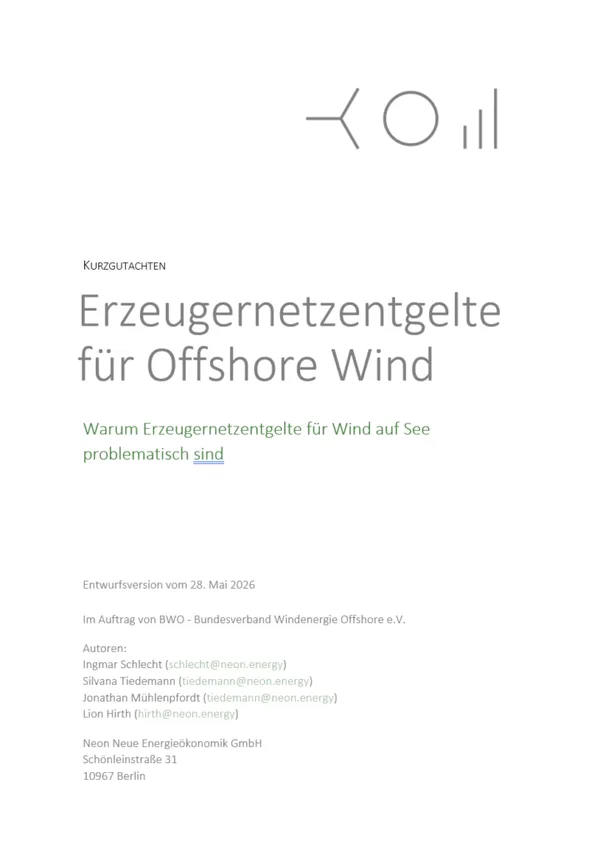
Injection charges for offshore wind (BWO). Germany’s regulator plans to charge generators for grid costs from 2029, aiming to relieve consumers and incentivize grid-friendly behavior. For the offshore wind association BWO, we find neither is met: as the state largely sets sites, connections, and capacity, the charge cannot steer behavior and raises CfD bids, burdening the federal budget. 2026. Report ▸
EE support scheme (BMWE). Germany is shifting its renewables support toward contracts for difference, requiring a redesign of the support framework. With our partners Guidehouse, Consentec, and Fraunhofer ISI, we provide conceptual advice on topics such as production-independent support and the treatment of negative prices, and quantify future support costs. Ongoing.
Management fee (SFOE). Switzerland’s move to a single-price imbalance settlement in 2026 requires updating the management fee methodology for renewables. For the Swiss Federal Office of Energy, we analyzed the current approach and developed a transparent formula reflecting balancing costs under the new market design. 2025. Report ▸
Progress report solar (BMWE). In this ZSW-led project with Bosch & Partner, we write the current edition of the German government’s regular progress report on solar energy, assessing the impact of dynamic tariffs and dynamic grid fees on small-scale solar. Dynamic tariffs set the financial value of solar power for prosumers. Ongoing.
Renewables support scheme (BMWE). Germany needs to reform its support scheme by January 2027. A particular concern is undistorted dispatch incentives for wind and solar energy. Along with our partners Guidehouse, Consentec, Fraunhofer ISI, and Becker Büttner Held, we provide the ministry with assessment and advice on various proposed reforms. Options include two-sided CfDs. 2024–26.
Excess electricity (BMWK). The fast expansion of solar energy comes at a price: because many investments are small-scale and subject to a feed-in tariff, they keep generating even if supply exceeds demand. In this project with Consentec, we forecast the probability of excess electricity situations for coming years and supported the German government in addressing the problem. 2024–25.
Dynamic FIT (50Hertz). Germany now has 60+ GW of solar capacity under the feed-in tariff, and those generators won’t stop producing even if oversupply sends wholesale prices into negative territory. For TSO 50Hertz, with Fraunhofer FIT, IEE, IEG, and BTU Cottbus, we developed a reformed feed-in tariff that incentivizes producers to turn off in situations of oversupply. 2024.
RE support scheme (BMWE). Germany needs to update its support scheme for wind and solar energy to comply with EU law; efficient dispatch incentives during negative prices are the central concern. With Consentec, we provided the ministry with assessment and advice on a range of options, from adjustments to the sliding market premium and incremental reforms to “financial CfDs”. 2024.