With the EU grid package, and parallel reforms across many European countries, grid tariffs are high on the political agenda. Rising grid costs due to massive network expansion have led many to call for contributions from generators and batteries. At the same time it is becoming ever more clear that dynamic grid fees will be needed for efficient incentives.
We advise DSOs and TSOs, policymakers and regulators, but also grid users like energy-intensive industry or generators on dynamic, regional, generator, and storage tariffs – from economic analysis and expert reports to concrete reform proposals. With our grid fee forecast, we help companies and investors anticipate future costs. Lion Hirth heads our work on grid tariffs.
The Economics of Power Grids (EN)
A comprehensive introduction to the technology, economics, operation, and regulation of electricity grids: from locational pricing and redispatch to network charges and dynamic grid fees. Designed for anyone who plans, operates, regulates, or uses electricity grids, from network operators to flexibility providers.
Grundlagen der Energiewirtschaft (DE)
Eine kompakte Einführung in Energie- und Netzwirtschaft sowie den politisch-regulatorischen Rahmen. Der Kurs vermittelt ein grundlegendes Verständnis von Stromsystem, Marktmechanismen und Regulierung. Für Berufs- und Quereinsteiger bei Energieversorgern und Netzbetreibern sowie in Projektentwicklung und Energiepolitik.
Industrial grid fees (multi client). The reform of Germany’s special industrial grid fees (§19(2) StromNEV) has been under way for several years. For a group of 17 energy-intensive companies, we develop a practicable model that meets the heterogeneous requirements of the different industries. Ongoing.
Costs of transformers (industrial company). The EU shields domestic makers of transformer steel through anti-dumping duties, and further trade measures are under discussion amid rising imports. For a steelmaker, we quantified how rising costs of transformer core steel would feed through to grid costs and tariffs for European electricity consumers. 2026.
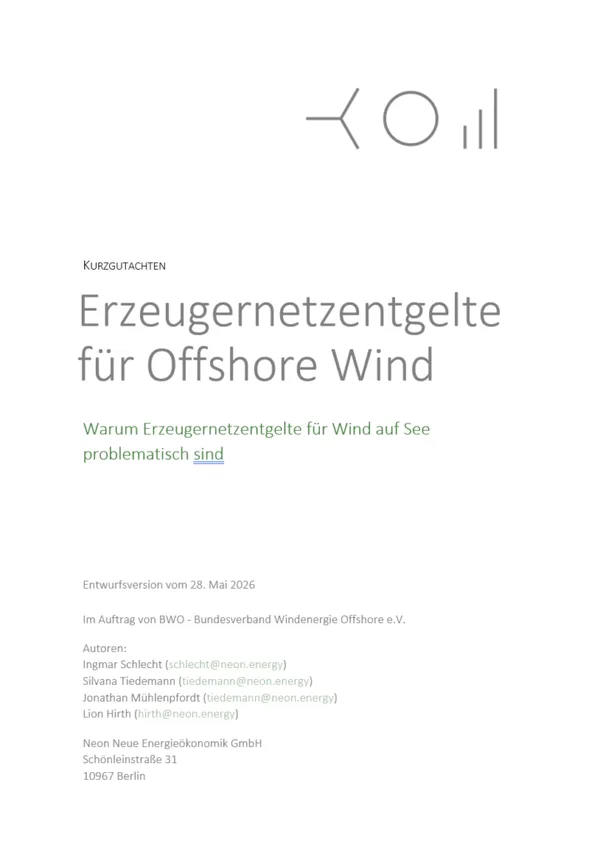
Injection charges for offshore wind (BWO). Germany’s regulator plans to charge generators for grid costs from 2029, aiming to relieve consumers and incentivize grid-friendly behavior. For the offshore wind association BWO, we find neither is met: as the state largely sets sites, connections, and capacity, the charge cannot steer behavior and raises CfD bids, burdening the federal budget. 2026. Report ▸
Dynamic grid tariff pilot (dena). In this pilot, with FfE and UnternehmerTUM, we develop a data-driven framework for dynamic grid tariffs that turns congestion into targeted price signals. We analyze load and price data, examine how price signals affect consumption, assess implications for flexibility business models, and run a field test with load control via smart meter gateways. Ongoing. Website ▸
Industrial grid fees (Aurubis). Building on Model C of Germany’s network regulator, we develop a proposal to reform industrial grid fee discounts. We identify grid operators’ needs, analyze the flexible processes of copper producer Aurubis, and specify key design parameters such as lead times and intervention frequency, keeping the grid benefit at the center. 2026.
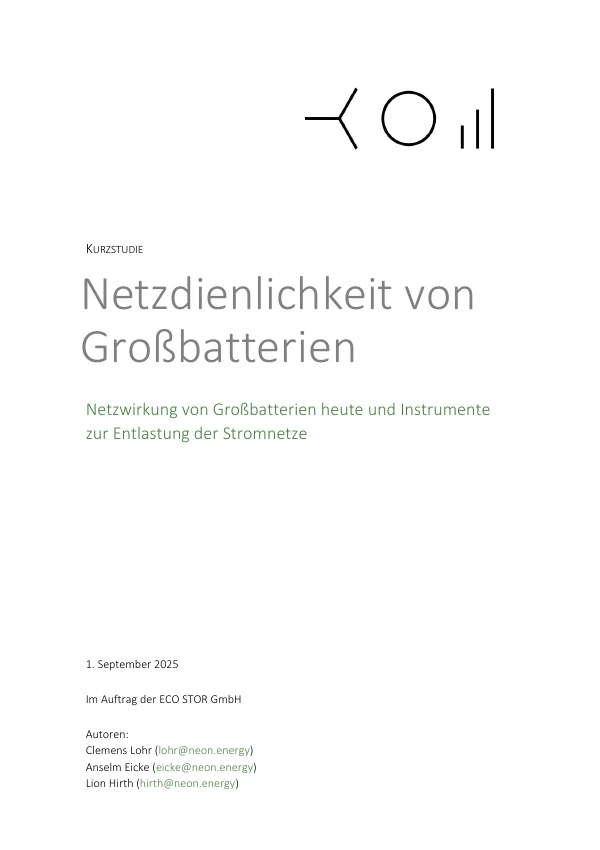
Grid-friendly storage (multi client). Germany plans dynamic grid tariffs for battery storage by the early 2030s. For Enspired, E.ON, EWE, and Green Flexibility, Neon, as a subcontractor to UnternehmerTUM, develops the methodology, translating local congestion into time- and location-specific price signals and testing calculation approaches and aggregation levels on real data. Ongoing.
Dynamic grid charges (EWE). Germany is redesigning its grid tariff system. As flexible assets increasingly optimize against spot prices, synchronization effects create new peaks in voltage-constrained grids. For grid operator EWE NETZ, Neon examines which of these problems time-variable or dynamic tariffs can address and simulates their effects on load, revenues, and cost allocation. Ongoing.
Grid tariff reform (Creos). Luxembourg’s power system is changing fast, requiring a reform of grid tariffs for medium- and high-voltage customers by 2027. The process involves grid operator Creos, distribution operators, the regulator, and the government. Neon supports it by structuring the reform, engaging stakeholders, assessing tariff options, and drawing lessons from other countries. Ongoing.
Grids & Benefits (UnternehmerTUM). Grids & Benefits is a pilot implementing dynamic grid fees together with TSOs, DSOs, and aggregators. Granular fees were published day-ahead and used for grid-friendly load shifting, yielding strong evidence of their impact on low-voltage consumption. For UnternehmerTUM, Neon led stakeholder management, quantitative analysis, and communication. 2025. Slides ▸
Injection charges (TenneT). Countries such as the Netherlands are discussing injection charges as a means to recover offshore grid connection costs, partly from foreign consumers. With our partner Consentec, we provided Dutch TSO TenneT with an economic assessment of such charges, cautioning in particular against capacity-based injection charges. 2024–25. Report ▸
Industrial grid tariff rebates (TenneT). For decades, Germany’s system of grid fee rebates for heavy industry has prevented industrial demand-side response. Finally, a reform window has opened. For transmission operator TenneT, we identified the numerous problems of the current rebates and developed a range of reform options. 2024. Report ▸